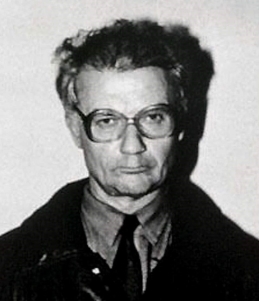
Who was the The Butcher of Rostov, Andrei Chikatilo

A native of the Ukraine, born October 16, 1936, Andrei Chikatiko was a late-blooming serial killer who traced his crimes back to early childhood. His family had suffered greatly during Joseph Stalin’s forced collectivization in the 1930s, Chikatilo said. Apart from knowing poverty and hunger, he had lost an older brother,
allegedly murdered and cannibalized by neighbors during the famine that claimed millions of Russian lives.
Whether the tale was true or not, young Andrei’s mother drilled it into him with frequent repetition, and his later deeds would replicate the act.
While most serial murderers kill for the first time in their teens or early twenties, Chikatilo was a slow starter. With a university degree, a wife and two children, he presented the appearance of a meek family man, but dark urges were brewing behind that pacific facade. Employed as a school dormitory supervisor,
Chikatilo was fired over allegations that he had molested male students. A new job, as a factory supply clerk in Rostov-on-Don, required frequent travel by bus or train, and Chikatilo turned the circumstance to his advantage, trolling for victims in bus depots and railway stations.
The self-described “mad beast” and “mistake of nature” committed his first murder on December 22,
1978, in the town of Shakhty. The body of his victim, a nine-year-old girl whom Chikatilo strangled, raped, and stabbed repeatedly, was pulled from the Grushevka River days later. Chikatilo was one of many suspects questioned in the case, but police soon focused on 25-yearold Alexander Kravchenko, an ex-convict who had served time for murder and rape. In custody, Kravchenko was beaten by police until he confessed, whereupon he was sentenced to death and shot by a firing squad. The “solution” looked good on paper, but it naturally failed to deter the real killer from striking again.
The terror began in earnest nearly three years later,
in September 1981. Over the next nine years, dozens of corpses would be found in wooded areas adjacent to train or bus depots, grossly mutilated by a phantom who was quickly dubbed the “Rostov Ripper.” The victims included young women and children of both sexes,
raped and stabbed repeatedly in a pattern of grisly overkill. Some victims had their tongues bitten off; others were disemboweled, sometimes with organs missing that suggested the killer might be indulging in CANNIBALISM. (Chikatilo later confessed to occasionally nibbling on internal organs but denied consuming human flesh.) Repeated stab wounds to the face were a specific trademark of the killer, but the mutilations he inflicted otherwise appeared to follow no set pattern.
Chikatilo may have come late to the murder game,
but he was making up for lost time. At the peak of his homicidal frenzy, in 1984, eight victims were found in the month of August alone. Chikatilo was held for questioning again that year and released for lack of evidence after Communist officials intervened on his behalf,
lamenting the “persecution” of a loyal party member.
It would take another six years, with some 25,000 suspects interrogated, before police came back to Chikatilo a third time and finally bagged their killer.
Part of the problem was communist mythology, maintaining that such “decadent Western crimes” as serial murder never occurred in a “people’s republic.” State censorship forbade police from broadcasting descriptions of their suspect–or even admitting his crimes had occurred–and homicide investigators were thus reduced to the same cloak-and-dagger routine that had retarded investigation of earlier, similar cases. Propaganda aside, however, there seemed to be mayhem aplenty in Rostov-on-Don: before it ended, the Ripper investigation would disclose 95 additional murders and 245 rapes committed by other human predators in the district.
Chikatilo finally ran out of luck in November 1990,
when he was spotted in a Rostov railway station, sporting bloodstains on his face and hand. While he was not arrested at the time, his name was taken down, and the discovery of another victim near the depot two weeks later prompted his arrest on November 20. After eight days of interrogation, Chikatilo confessed a total of 55 murders, leading police to several corpses they had not discovered yet. His recitation of atrocities–illustrated by demonstration on mannequins–included sadistic mutilation of several victims while they were still alive.
Charged with 53 counts of murder, Chikatilo went on trial in June 1992; four months later, on October 15,
he was convicted on all but one count and sentenced to death. A last-minute appeal for clemency was rejected by President Boris Yeltsin in February 15, 1994, and Chikatilo was executed that same day, with a pistol shot to the back of his head. Alexander Kravchenko,
meanwhile, was posthumously pardoned for the slaying of Chikatilo’s original victim.
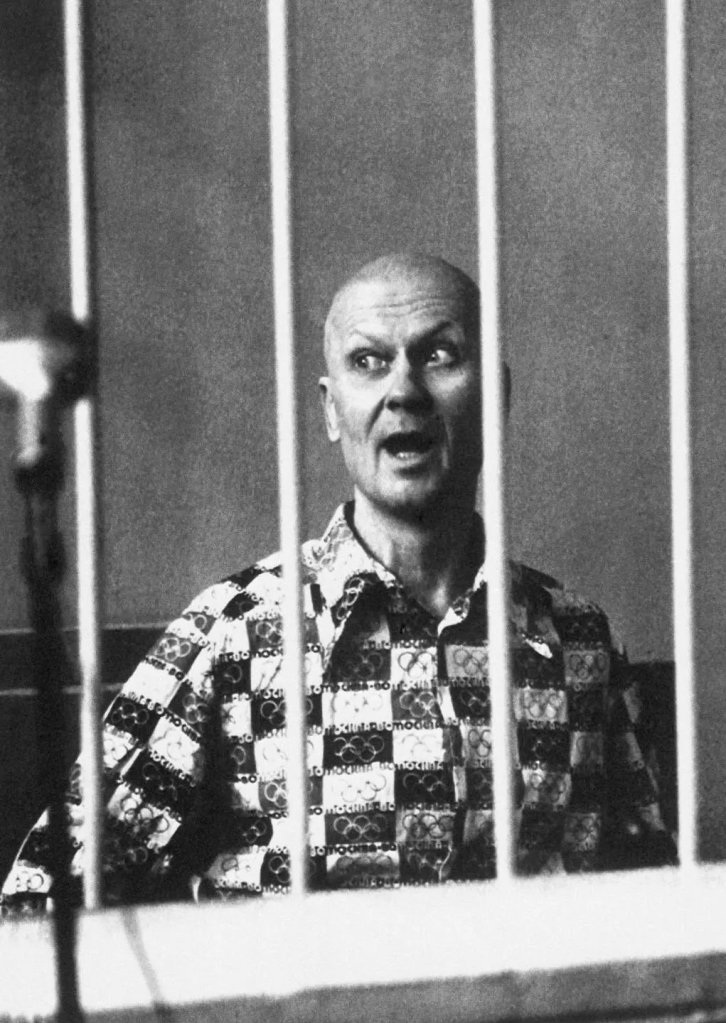
Chikatilo, pictured at his trial in April 1992

Reference

1. Andrei Chikatilo

2.
53 Killed, Man on Trial”. The Canberra Times. 16 April 1992.

3.Cullen, Robert (1993). The Killer Department: Detective Viktor Burakov’s Eight-Year Hunt for the Most Savage Serial Killer in Russian History (First ed.). New York City: Pantheon Books. ISBN 0-679-42276-5.
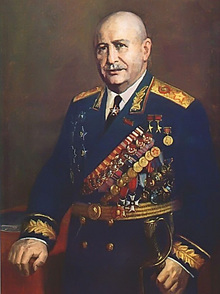
Bagramyan, Marshal Ivan

Image from
http://www.pobeda-1941-1945.narod.ru


At the beginning of World War II. Bagramyan served as a Soviet staff officer on the Southwest Front, as Chief of Operations Department in the Kiev Military District and also as Chief of Staff to TIMOSHENKO after BUDENNY’s dismissal. He was given command of an army, the 16th Guards (later the 11th Guards), in July 1942. His army fought on the Western Front and at Kursk (July 1943) where it attacked from the north and achieved the envelopment of Orel. In November 1943 he was promoted to General and replaced YEREMENKO as Commander of First Baltic Front, which became known as the Samland Group in later operations. During the Belorussian campaign his armies unexpectedly broke through in the north and encircled Vitebsk killing 20,000 Germans and capturing 10,000. The Front Armies then crossed the Dvina, took Daugavpils and reached the coast west of Riga. Now all that was left was to complete the encirclement of German Army Group North. In January 1945 his Group occupied Memel and was then ordered to take Königsberg. This proved a stumbling block and Bagramyan was held responsible for the failure to take it until April 1945. After the war he was appointed Commander of the Baltic Military District.

Source: Who is Who in World War II 2013

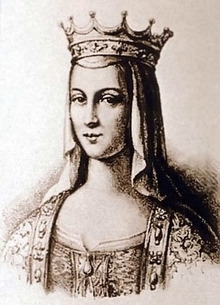
Anna Yaroslavna

History books remember her as a golden-haired girl from an exotic land who became queen consort and, later, regent of France. Anna was born to Yaroslav the Wise   – grand duke of Kiev and the initiator of the “golden age” of Rus – and his wife Ingegerd. Her parents insisted on giving her a good education and, by the age of 18, under the supervision of her mother, she had mastered Latin, Ancient Greek and the basics of medicine.

https://visitrussia.tumblr.com/post/190534256411/anna-yaroslavna-the-daughter-of-the-wise-history

In 1048, the French embassage, led by the Bishop of the city of Meaux Gautier and minister of the French Court Goscelin de Chalignac, arrived in Kiev with a mission to arrange a marriage between the king of France, Henry I, and Anna. Rumors of Anna’s exquisite beauty, literacy and wisdom reached many corners of Europe.

Historians still debate the reasoning behind Henry’s choice of a second wife: France did not have any diplomatic or trade links with Rus at the time. However, the general consensus is that Henry couldn’t find a suitable princess-bride in Europe – all the eligible young women were related to him within illegal degrees of kinship.

Apart from the king’s best regards, the entourage brought exquisite swords, broadcloths and silver dishes to demonstrate their serious yet friendly intentions to woo. Being a prolific father as well as a wise ruler, Yaroslav sought to consolidate his leadership of Kiev and to give a comfortable future to his children. Profitable marriages would kill two birds with one stone. And Anna’s marriage to Henry I was the most successful one of them all.

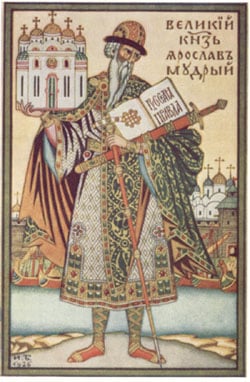
Ivan Bilibin’s artwork of Yaroslav I.

The king was more than 40 at the time of the couple’s first meeting; he suffered from obesity and became spiteful, even with his concubines. However when he saw Anna, he softened and even smiled, leaning in to kiss her. After this passionate introduction, Anna is quoted to have pulled back, blushed and said: “I suppose it is you who is king…”

Queen of France

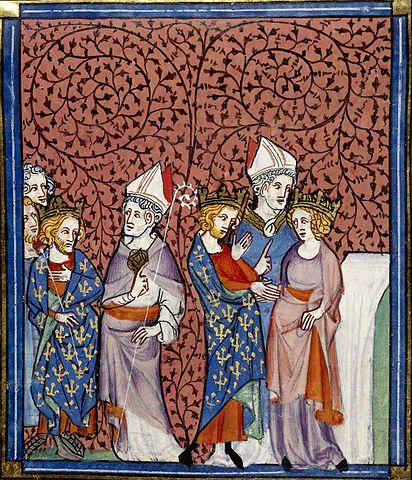
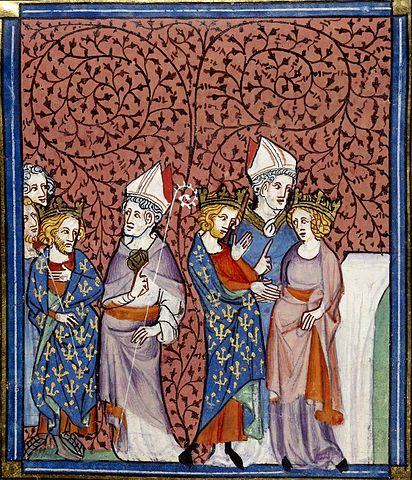
Their wedding – as well as Anna’s coronation as Queen of France – took place in May 1049, Holy Trinity Day, in the Cathedral of the city of Reims, long-established as the site of the coronation of French kings. On the marriage contract, Anna gracefully signed her name and patronymic whilst the king of France simply put down a cross.

Photo credit :https://history.info/wp-content/uploads/2016/05/412px-Henry1AnneKiev.jpg

At her coronation, the newly-wed queen broke with tradition: instead of conforming to tradition and taking her royal vows with her hand placed on a Latin Bible, she used a Slavic Gospel, which she brought from Kiev with her.

Her letters of the period show that she wasn’t fond of her new homeland, thinking it was too provincial in comparison to Kiev. In 1050 she writes to her:

father: “What a barbarous country you sent me to – the dwellings are somber, the churches horrendous and the morals – terrible”.

There is little information regarding how Anna was received at the French court. She was, however, quick to learn the French language and keenly participated in government affairs, despite having a merely decorative post. Her name can be found on official documents, next to the king’s ever-present X. The signatures read “by the approval of my spouse Anna” or “in the presence of Queen Anna”.

However, the young queen couldn’t produce an heir for a long time, which probably created tension and sparked unwanted rumors. She is said to have spent long hours in prayer, pledging to found a monastery if she would successfully give birth to a prince. Finally, either thanks to her active spirituality, or more likely to the untiring efforts of her 45-year-old husband in 1053, she gave birth to her first-born son, christened Philip. Henry and Anna had two more children: Robert who died in adolescence as a highwayman, and Hugh (Hugues), who joined the first Crusades.

In 1060 Henry died, leaving the French throne to Philip, who was only seven years old at the time. Anna became the regent ruling the country in the name of her son. True to her word, she founded a monastery dedicated to St Vincent in Senlis, not far from Paris. Only a chapel has survived. A monument to Anne of Rus still stands next to the chapel. Like his father before him, Philip took Anna’s advice seriously, and her signature can be found on official documents next to his.